Platform
OverviewReproducibilityUse Cases
Research QuestionsCase StudiesPilot
PilotResources
BlogPublicationsCompany NewsCompany
About UsAdvisory BoardContactIn oncology research, speed and reproducibility make all the difference. This article shows how our collaboration with TME Pharma uses agentic AI and automation to accelerate discovery and improve the quality of scientific insight.

For TME Pharma, which focuses on developing therapies that target the tumor microenvironment, our partnership means being able to test hypotheses more quickly, validate results with greater confidence, and accelerate the path from data to discovery. Instead of waiting weeks for data-crunching or screening results, analyses that once took an entire team a month can now run in under 30 minutes with our platform’s scalable infrastructure—a transformation in turnaround time that lets research teams iterate in real time.
This agility is crucial in oncology research. Cancer biologists today grapple with high-dimensional data (genomic sequences, protein expression profiles, imaging data, etc.), and hidden within are patterns that might unlock new treatments. AI excels at spotting these subtle patterns: for example, advanced deep learning models can sift through millions of data points or compounds far faster than any human, often uncovering potential biomarkers or drug candidates that would otherwise remain hidden. Modern high-throughput labs might test 100,000 compounds in a day in wet-lab experiments, but AI-based virtual screening can go even further—recent studies report screening millions of compounds in just a few hours using machine learning on modest computing hardware.

By deploying such technology, TME Pharma’s scientists can evaluate a far wider range of therapeutic candidates in silico, rapidly narrowing down the most promising leads. Together, we’re building an environment where oncology research can move at the speed modern science demands, without sacrificing accuracy. When AI accelerates discovery and human expertise ensures biological validity, it creates a powerful feedback loop: each experiment informs the algorithms, and each algorithmic insight guides the next experiment. This synergy makes the research process not only faster, but smarter.
No organization can reshape an industry in isolation. History has shown that breakthroughs often emerge from the intersection of different skills and perspectives. In biomedicine especially, progress depends on partnerships – bringing together those who understand the biology, those who excel at data science, and those who build cutting-edge technology. Recent industry data underscores this collaborative imperative. For example, a survey by Strategy& found that 85% of pharma executives see partnerships as vital to innovation.
It’s no surprise then that we’ve seen an explosion of collaborative efforts across the sector, from big pharma partnering with AI startups, to public-private consortia tackling common challenges. These collaborations are fueling progress: between 2011 and 2016 the FDA approved 204 new medicines, up from 131 in the previous five-year period—an increase partly attributed to companies pooling expertise and resources to overcome R&D hurdles. Partnerships truly accelerate discovery by letting each party focus on what they do best while jointly attacking the tough problems.
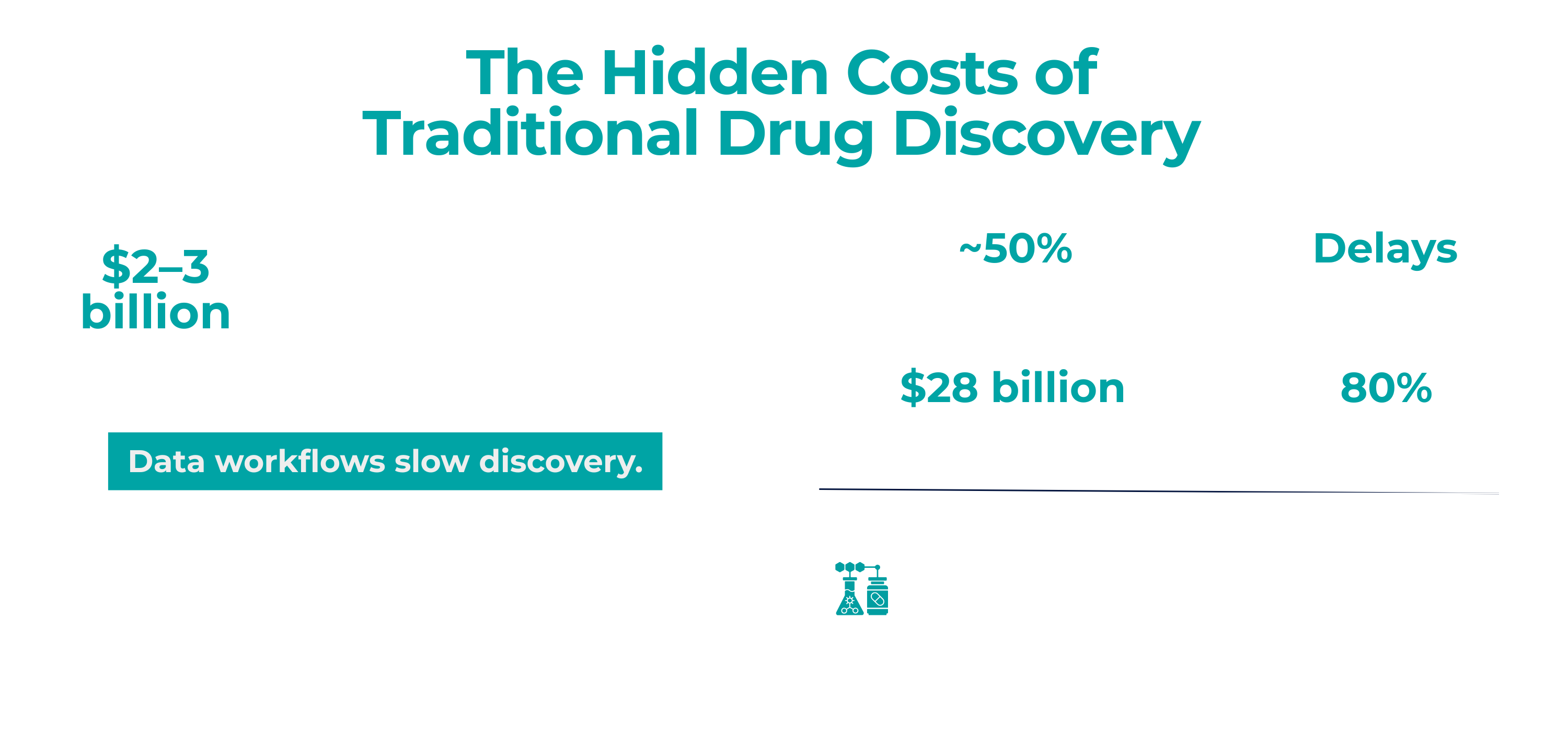
At aimed analytics, partnerships are central to how we work. Our philosophy is that combining strengths multiplies outcomes. We provide an AI-driven analytics platform purpose-built for biomedical research, and we collaborate closely with domain experts like TME Pharma who bring deep disease-area knowledge. This model allows us to address the biggest pain points in drug discovery together. Consider the traditional approach: a pharma company might spend weeks analyzing experimental data or trying to identify a drug target, then start new experiments, and so on—a sequential, time-consuming cycle.
By contrast, in a collaborative, AI-augmented approach, much of the data analysis is automated and accelerated, compressing those weeks into mere hours. Multiple reviewers can analyze combined datasets simultaneously, boosting statistical power and minimizing bias. The net effect is not just a faster pace, but also better science. Indeed, studies show that companies running 3–5 drug projects per year can generate over $400 million in added value by saving 9–12 months across their portfolio with such efficiencies.
These tangible benefits—faster progress, lower costs, higher success odds—are why forward-thinking organizations are joining forces. As one industry report noted in 2025, 70% of pharma leaders now say that adopting AI is an “immediate priority”, and many of them plan to pursue it through external collaborations. In other words, the most innovative companies recognize they must partner to stay at the forefront. Our alliance with TME Pharma is a prime example of this mindset in action.
TME Pharma’s vision is clear: to pioneer new therapies that reprogram the tumor microenvironment, giving patients better options and outcomes in the fight against cancer. At aimed analytics, our mission is complementary: to make biomedical data analysis faster, cheaper, and more reliable, so that breakthroughs can happen at a dramatically accelerated pace.
Both organizations believe in the same principle: AI is not a future add-on—it is the next frontier in drug discovery, here and now. This isn’t just a slogan; it’s reflected in the broader industry trajectory. The global sector for AI-driven drug discovery is growing rapidly, projected to expand from roughly $1.8 billion in 2024 to over $13 billion by 2035. That kind of tenfold growth in investment signals a collective understanding that AI will be integral to the next generation of medicines.
By combining our platform’s analytical power with TME Pharma’s oncology expertise, we create a research process where data and science reinforce each other at every stage. AI can crunch numbers and detect patterns at a scale no human team could match, but it takes seasoned scientists to ask the right questions and interpret the results in a biological context. This synergy is exactly our shared mission in action. We’ve seen what such synergy can achieve elsewhere: for instance, the first drug molecule designed by AI entered clinical trials recently after only 12 months of development—a feat achieved by a collaboration between AI experts and pharmaceutical researchers.
Both our teams are deeply committed to the idea that AI isn’t just hype or a side project; it’s a core part of how we advance therapeutic science going forward. Indeed, the recognition of AI’s value reached the highest levels of science in 2023, when the Nobel Prize in Chemistry was awarded for AI-based models that enable remarkable prediction of molecular structures.
That achievement exemplifies the paradigm shift underway: computational models can now solve problems once thought intractable. TME Pharma and aimed analytics share a resolve to harness this power responsibly and effectively. In practice, that means we set common goals, integrate our workflows, and maintain a constant dialogue between biologists and data scientists. Every discovery program we undertake together is guided by this combined perspective. We are jointly pushing towards one ultimate goal: get new, effective treatments to patients faster. And we know that by aligning our efforts, the sum will be greater than the parts.
At the core of this collaboration is the technical integration of our AI-powered analytics engine with TME Pharma’s ongoing research programs. In simple terms, we’ve plugged a cutting-edge AI brain into an expert-driven oncology workflow. Here’s how the pieces come together:
The promise of AI in drug discovery is not just speed—it’s also precision, reproducibility, and scalability. Our partnership with TME Pharma is a case study in how these values translate into real-world progress. Here are the key ways this approach is shaping the future of pharmaceutical R&D:
For patients and the broader healthcare ecosystem, the implications of these advances are profound. Faster development timelines mean that effective drugs reach the market sooner, potentially saving lives or improving quality of life for patients who cannot wait long. Lower R&D costs can translate into more affordable therapies and a more sustainable healthcare system (if it costs billions less to develop a drug, payers and patients may ultimately bear lower costs). And a greater number of drug candidates increases the odds of tackling diseases that have eluded cures so far—including aggressive cancers that are TME Pharma’s focus.
In sum, partnerships like the one between aimed analytics and TME Pharma demonstrate a model for drug discovery that is quicker, more cost-efficient, and more innovative. It heralds a future where we can respond to urgent medical needs with agility and where the word “breakthrough” might become a more frequent part of the medical lexicon.
👉 Join us in accelerating the path from discovery to treatment.
This collaboration is only the beginning. By building strong partnerships, we aim to redefine how biomedical research is conducted—not only in oncology, but across the life sciences. We envision a future where AI-powered, collaborative research is the norm: where pharmaceutical companies, biotech startups, AI firms, and academic labs form a network of innovation, each contributing their strengths. In such an ecosystem, data flows more freely (with proper safeguards), hypotheses are tested more rigorously (thanks to computational support), and successes are shared to propel the whole field forward. Our platform provides the tools; our partners bring the expertise. Together, we are reshaping the future of drug discovery.
It’s worth noting that the industry at large is moving in this direction. A recent report found that 40% of top pharma leaders plan to pursue AI initiatives through external partnerships, rather than relying solely on in-house efforts. The rationale is clear: the challenges of modern drug R&D—big data, complex biology, high failure rates—are too large for any single entity to solve alone. Collaboration isn’t just a buzzword; it’s becoming a best practice for innovation. We’re proud that our partnership with TME Pharma exemplifies this ethos. Together, we’ve created a blueprint for how AI specialists and disease specialists can join forces to achieve what neither could alone.
Looking ahead, we are excited to expand this model to new domains and new partners. Today it’s cancer and the tumor microenvironment; tomorrow it could be neurodegenerative diseases, rare genetic disorders, or global health threats where speed is of the essence. The beauty of an AI-driven analytics platform is that it’s adaptable—the same framework accelerating oncology research can be applied to other therapeutic areas with the right expert collaborators. We’re already investing in making our platform more powerful, integrating the latest advances in machine learning (from generative AI that can design novel molecules, to federated learning that allows AI training on distributed data securely). But technology alone doesn’t change the world—people do, through cooperation.
In building the future together, we remain committed to the core principle that guided this partnership: when great science is augmented by great technology, amazing breakthroughs happen. TME Pharma’s cutting-edge oncology research combined with aimed analytics’ AI expertise is showing what’s possible. We invite others to join us on this journey. Whether you are a biotech company looking to turbocharge your R&D, a pharma company seeking to inject AI into your pipeline, or an academic group with deep insights into disease biology, the door is open. By uniting our strengths, we can push medicine forward in ways that truly seemed like science fiction just a decade ago.
The future of drug discovery will be written by collaborators. Partnerships like ours are lighting the way, demonstrating tangible benefits – from dramatically shortened research cycles to an expanded universe of therapeutic possibilities. We’re not just talking about theoretical improvements; we’re seeing them materialize. And ultimately, the greatest beneficiaries of this new paradigm are the patients waiting for cures. That knowledge fuels our commitment to collaboration even further.