

An Agent for the Few Papers You Can't Afford to Miss
Every week, roughly 21,000 new articles show up in just one biomedical database — and somewhere in that flood are the handful of papers you actually can't afford to miss. What if an agent did the watching, so you didn't have to?
The Problem Isn't Finding Papers. It's not Missing The Right Ones.
A search for multi-omics combined with any disease of interest rarely stays small. Even a fairly specific combination like multi-omics + alzheimer returns over 29,000 full-text results on PubMed Central alone — a broad search result count, not a claim that all 29,000 are relevant.
And that's exactly the point: long before anyone gets to judging relevance, the sheer size of the list is already the problem.
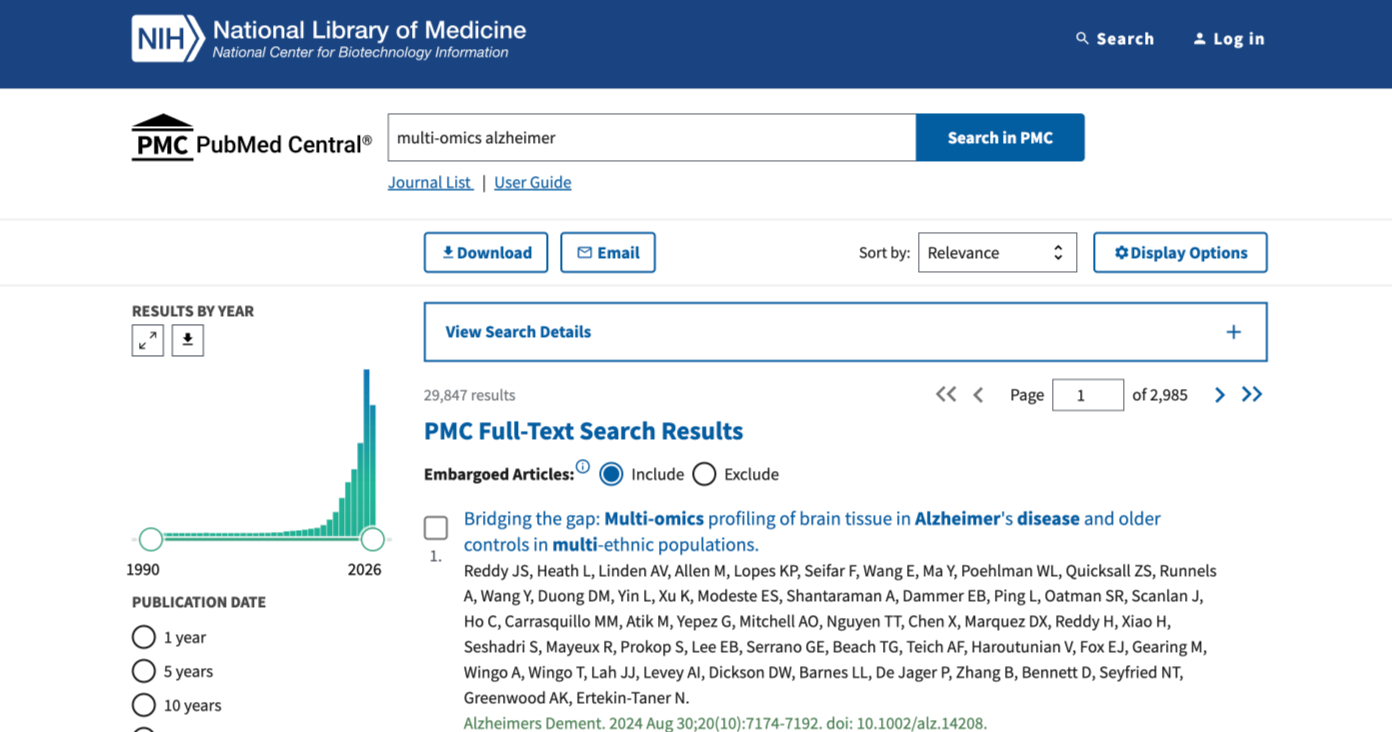
That's the moment most researchers know well: the search bar promised an answer, and instead handed you a part-time job.
The Problem: There's Simply Too Much to Read
This isn't a niche complaint. PubMed alone — just one of several databases researchers search — now indexes more than 40 million citations for biomedical literature. And it isn't standing still: one recent paper on literature-screening tools notes that the biomedical literature grows by an average of 3,000 new articles a day — which, multiplied out across a normal week, lands somewhere around 21,000 new articles arriving every week, just in this one database.
It's not just a numbers problem in the abstract — researchers say so directly. As one paper on citation network analysis puts it, plainly:
 Researchers cannot keep up with the volume of articles being published each year.
Even within a single, well-defined subfield, a routine search can return tens of thousands of hits. Put differently: Just doing a literature search can mean landing on a five-digit number of results before anyone has read a single full text — and that's before deciding which of those thousands are actually relevant to your specific question.
The real challenge, then, isn't finding papers. It's not losing the handful that actually matter inside a pile that size — and doing that without a human reading every single entry to find out.
A Thought Experiment: What If You Just... Didn't Miss Anything?
Sit with that weekly number for a second — roughly 21,000 new articles landing in one database, every week, across every field of medicine and biology combined. Now imagine narrowing that flood down to just your corner of it: your omics type, your disease area, your specific methods. It's still not zero. It's still more than any one person reads in a week, on top of actually doing the research.
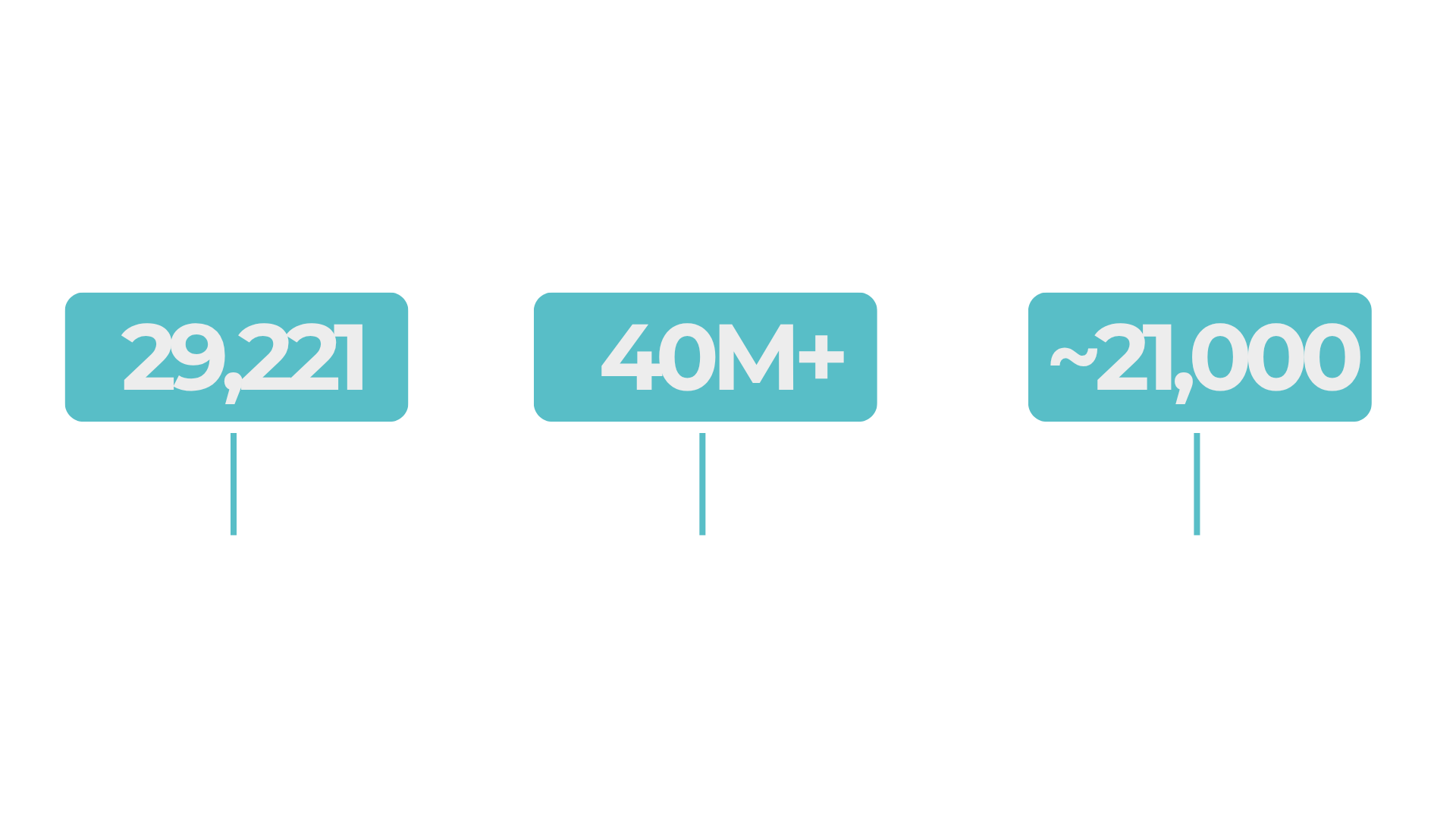
Here's the thought experiment worth running: what would it actually mean to not miss anything relevant in that stream, without spending every spare hour scanning titles? Not read everything (nobody has time for that, and nobody should), but "know that the handful of things that matter to you specifically didn't slip past unnoticed."
That's a different problem than find me papers. It's closer to a filter that runs continuously in the background, quietly doing the triage a person would do if they had unlimited reading time — flagging what's worth a closer look, and staying out of the way on the judgment calls that are still a person's to make.
What Researchers Actually Wish For
It's not that nothing exists to help. Tools like Elicit, PaperQA, and ASReview already help researchers search, summarize, and rank papers by relevance, and plenty of people already lean on AI-powered search engines that generate short summaries or highlight influential work in a field.
What most of these tools have in common, though, is that they answer a question you ask once: you type a query, they return a ranked, summarized set of results for that moment. What's different about the idea sketched out here is the shift from a one-off search to a standing watch — not "give me results for this query today," but "keep watching this defined slice of the literature, week after week, and only surface something when it's actually worth my attention."
Talk to researchers about what they'd actually want from something like that, and a pattern shows up:
- Don't just list results — tell me what they mean. A title and abstract isn't enough to decide if something's worth 20 minutes of your afternoon, let alone which one out of a few thousand deserves that time.
- Filter for relevance to my work, not just my keywords. Two papers can share a keyword and be worlds apart in usefulness.
- Show me what's trending, not just what's new. A single new paper is a data point. Several papers converging on the same finding within a short window is a signal.
- Save my time on the parts that don't need a human yet. Screening through a wall of abstracts to find the few worth reading closely is exactly the kind of task that benefits from automation — the judgment on what to do with those few papers stays with the researcher.
The Idea: An Agent That Watches So You Don't Have To
This is where an agentic approach gets interesting — not as a way to return more results, but as a way to do the sorting before a human ever sees the list. Picture an agent that sits on top of that ~21,000-a-week stream, watching a defined slice of it — say, genomics, transcriptomics, or epigenomics — and comes back not with a pile of links, but with something closer to a briefing.
Concretely, that could mean:
- Defined sources and scope. Watching specific databases (PubMed, bioRxiv, and similar) within a field you set — broad enough to catch what matters, narrow enough to stay useful. Even a narrow slice of a 21,000-article weekly stream is still a lot to hand to a person unfiltered.
- Relevance filtering that goes beyond keywords. Filtering by citation activity, journal reputation, and — importantly — by how closely a paper's methods or findings connect to your own work, rather than just whether the right words appear in the abstract.
- Trend detection. If the same finding or method starts showing up across several independent papers in a short window, that gets flagged differently than an isolated result. This is arguably where an agent could add the most value: spotting a pattern across dozens of papers is exactly the kind of thing that's tedious for a person and comparatively fast for a machine.
- A short, human-readable summary per paper. What it's about, why it might matter, in a few sentences — enough to decide if it's worth your time, not a replacement for reading it.
- A weekly digest, not a firehose. One report, a handful of entries, each with a plain-language "why this might matter to you" — instead of a five-digit list of unsorted hits.
Taken together, the thought experiment becomes a design question: out of ~21,000 new articles a week, how far can you narrow that down — automatically, continuously, without a person doing the first pass — before what's left is actually a list a human can act on in ten minutes over coffee?
And just as importantly: how do you narrow it down without ever quietly overstepping into deciding what's true, rather than just what's worth a look?
The Honest Part: Where an Agent Like This Would Stop
Worth being upfront about, because it matters more than the flashy version of this idea: something like this would be a brainstorming and screening partner, not a decision-maker.
Language models are genuinely good at exactly the task described here — scanning, summarizing, spotting patterns across text at a scale no person could match in the same time. That's real, and it's not nothing. But judging whether a finding is methodologically sound, whether it applies to your specific question, or whether it's actually worth building on — that still needs a person who knows the field. An agent could hand you a shortlist and a reason for each entry. It shouldn't be the one deciding what goes in your next experiment or your next paper's related-work section.
That distinction is also, honestly, the same principle behind everything we build at aimed analytics: AI should remove the bottleneck, not the biologist. Our platform lets researchers ask questions of their own omics data directly instead of waiting weeks for a bioinformatics pipeline, while the interpretation and the judgment calls stay firmly with the person who understands the biology. A research-finder agent, in whatever form it eventually takes, would follow the same logic, just one step earlier in the process: less time spent finding out what to read, more time spent actually thinking about it.
Why This Is Worth Talking About
We don't have a finished tool to announce here — just a problem we think is worth naming, and a direction we find genuinely promising. Not "another database to search," but a way to give researchers back the hours they currently spend just figuring out which of thousands of results, arriving at a rate of roughly 21,000 a week, contains the few papers they actually can't afford to miss.
If the idea of an AI that clears the noise so you can focus on the science sounds useful to you, we'd like to hear what such a tool would need to actually earn a spot in your weekly routine.
Sources
PMC full-text search "multi-omics alzheimer" — 29,221 results, as of August 2026. Live/dynamic number, changes with every new publication. As clarified in the text: a raw result count from a broad search, not a claim that every result is relevant.
Official PubMed homepage — "more than 40 million citations," direct NLM statement.
"PubMed and Beyond: Biomedical Literature Search in the Age of Artificial Intelligence" (ScienceDirect / arXiv, 2023–24) — states verbatim "an average of 3,000 new articles per day" for the biomedical literature. The ~21,000/week figure is our own calculation (3,000 × 7 days), not a weekly figure stated in the paper itself — but the daily rate comes directly from the source.
"Using citation network analysis to enhance scholarship in psychological science" (PLOS ONE, 2022) — direct source of the quote "researchers cannot keep up with the volume of articles being published each year."
Elicit, PaperQA, ASReview — existing tools referenced in the "What Researchers Actually Wish For" section for comparison.