

From Start-up to Global Platform: Our 5-Year Vision
Where we’re headed — and why we won’t stop until biomedical data analysis is accessible to every research team
Biomedical research does not suffer from a lack of ideas or ambition. It suffers from friction.
Across biotech, pharma, and academia, researchers generate high-quality data every day — but too often, progress slows when it comes time to analyze, interpret, and act on that data. Access to robust analytics still depends on budget size, internal bioinformatics capacity, and the availability of specialized talent.
We believe this imbalance is no longer acceptable.

Our vision is simple, but ambitious: every research team, regardless of size, should be able to turn complex biomedical data into reliable insight — quickly, reproducibly, and without unnecessary barriers.
This article outlines how we’re working toward that goal over the next five years.
The Mission Today: Democratizing Biomedical Analytics
Today, advanced data analysis remains concentrated in well-funded organizations with dedicated bioinformatics teams. Smaller biotechs, academic labs, and early discovery groups often face a different reality:
- analyses take weeks instead of hours
- workflows depend on a few individuals and custom scripts
- results are difficult to reproduce or extend
- iteration slows because every change requires rework

Our platform was built to address exactly these pain points.
At its core, aimed analytics removes unnecessary technical friction from biomedical data analysis. Researchers interact with the system by asking scientific questions, not writing code. Agentic AI translates those questions into transparent, reproducible workflows — selecting methods, configuring parameters, and documenting every step.
What this enables today:
- RNA-Seq and other omics analyses that run in minutes, not weeks
- standardized, auditable workflows that can be reused and shared
- faster hypothesis testing without sacrificing statistical rigor
- reduced dependence on scarce bioinformatics capacity
Democratization, for us, doesn’t mean “simplifying science.”
It means making high-quality analysis accessible without lowering standards.
What’s Next: Expanding Capability Without Adding Complexity
As biomedical research evolves, so does the complexity of the data. Our roadmap reflects that reality — and is guided by direct feedback from research teams using the platform.
Broadening Omics Coverage
RNA-Seq is only the beginning. Over the coming years, we’re expanding support for additional data modalities, including:
- proteomics and phosphoproteomics
- multi-omics integration
- spatial and single-cell datasets
- emerging assay types as they mature
The goal is not to build isolated tools for each data type, but to provide a unified analytical environment where results from different modalities can be explored together.
Deeper Biological Context
Analysis does not end with differential expression tables.
We’re investing heavily in:
- pathway-level interpretation
- cross-condition and longitudinal comparisons
- biologically meaningful summaries that support decision-making
As personalized medicine becomes more prevalent, researchers increasingly need to understand which signals matter for which subpopulations. Our platform is designed to support that shift — from average effects to biologically and clinically relevant stratification.
Scaling for Real Research Environments
As teams grow and datasets multiply, analysis must scale without becoming brittle.
That means:
- cloud-native execution that handles increasing data volumes
- consistent performance across projects and collaborators
- governance, access control, and auditability suitable for regulated environments
Our focus is not just on adding features, but on ensuring that complexity never leaks back to the user.
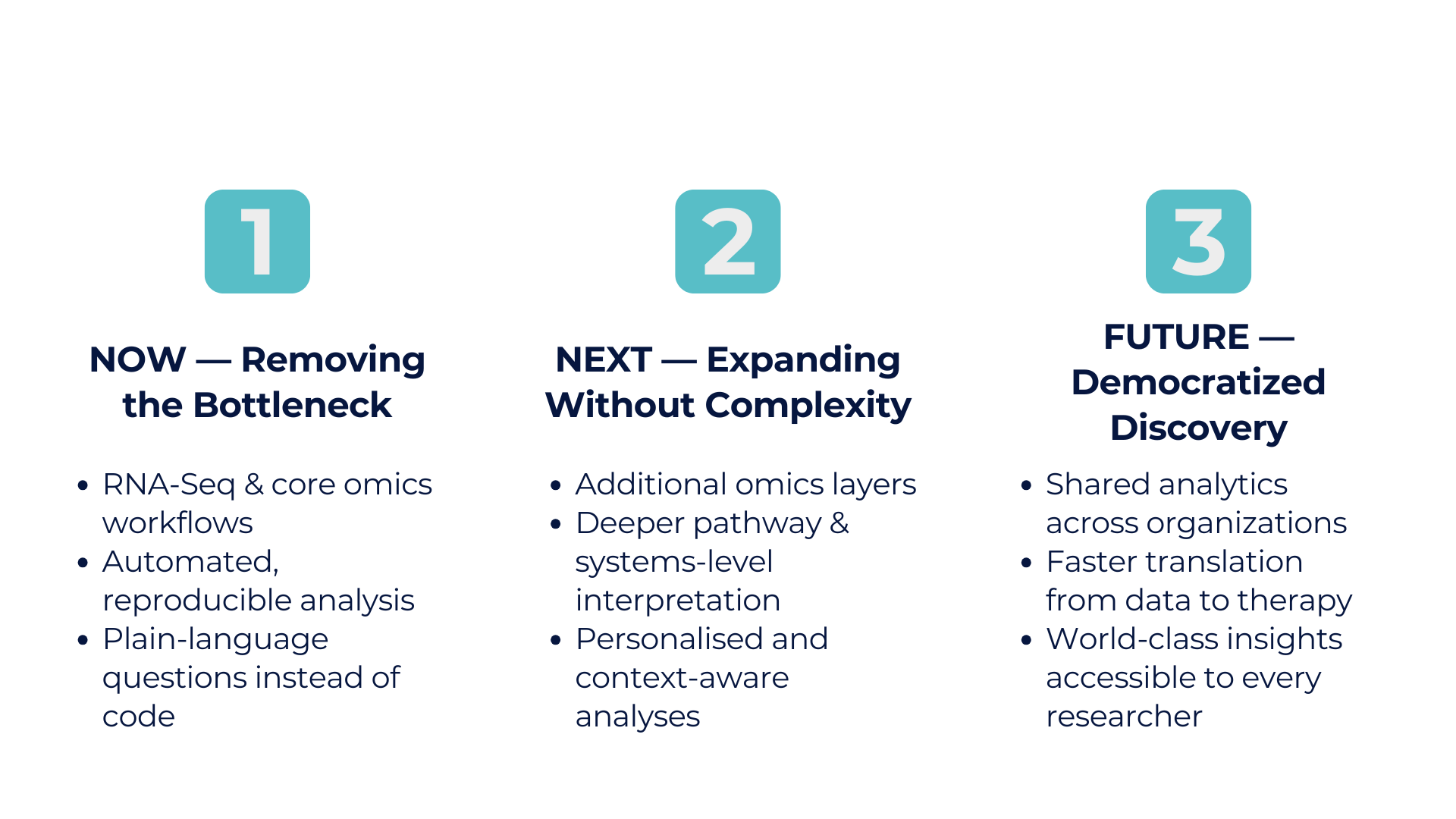
The Big Picture: Changing How Discovery Moves Forward
When analysis becomes faster, more reproducible, and easier to iterate on, the impact compounds.
- Drug discovery pipelines move more quickly from data to decision
- Failed hypotheses are identified earlier, saving time and cost
- Promising signals are validated with greater confidence
- Collaboration improves because workflows and results are transparent
In practical terms, this means:
- faster progression from discovery to development
- better use of research budgets
- increased confidence in results shared across teams and partners
At a broader level, democratized analytics changes who gets to participate in innovation. Smaller biotechs can compete on insight, not headcount. Academic labs can explore data more deeply without waiting on external resources. Collaborative projects become easier to manage because analysis is no longer a bottleneck.
This is how AI creates value in biomedicine — not by replacing scientists, but by removing friction so science can move at the speed it deserves.
Looking Ahead
Our five-year vision is not about becoming bigger for its own sake. It’s about becoming more useful — to more researchers, working on more important problems, with fewer barriers in their way.
The problems facing biomedical research are complex, but the direction is clear.
Data will continue to grow. Expectations for speed and reproducibility will increase. Teams will need tools that scale with both ambition and responsibility.
We’re building aimed analytics to meet that future — step by step, grounded in real research needs.
Follow our updates or get in touch to explore how we’re shaping the future of biomedical data analysis.