

Why Biomedical Data Analysis Needs a Reset - And How We Enable It
Biomedical research is producing data at unprecedented scale, yet traditional analysis methods remain slow, costly, and difficult to reproduce. It’s time for a reset — with agentic-AI-driven automation enabling faster, more reliable insights.
Biomedical Data Is Booming, but Analysis Is Falling Behind
For biotech companies, data is both a blessing and a bottleneck. Genomics, transcriptomics, proteomics, and metabolomics all generate massive, complex datasets — each requiring specialized analysis pipelines.
Yet traditional bioinformatics is slow, manual, and expensive. Projects stall while results are processed or re-run. Even simple RNA-seq comparisons can take weeks of work, leaving teams waiting when they should be moving toward discovery.
This imbalance between data creation and data interpretation is holding innovation back. It’s time for a reset.
The Challenge of Omics Data
Omics datasets are large, complex, and multi-dimensional, demanding advanced pipelines, sophisticated statistics, and reproducible workflows. Yet most biotech teams face three major hurdles:

The Cost of the Status Quo
Traditional analysis workflows remain expensive, slow, and prone to hidden inefficiencies. In institutional cores or service facilities, full RNA-seq analysis packages (alignment, statistics, visualization, enrichment) often command substantial fees.
For example, the UCSF Functional Genomics Core lists $1,000–$2,500 as typical costs for a bulk RNA-seq experiment, with additional or standalone bioinformatics charged at $89/hour depending on complexity. A small-to-medium dataset often requires around 3 working days of active bioinformatician time — assuming no re-runs or debugging.
However, microcosting studies in genomics emphasize that true cost estimation must include labor, equipment depreciation, consumables, and overhead — all of which add uncertainty to final cost estimates.

Because many projects require iterations, extra QC, or re-running pipelines, actual costs often rise well above initial estimates. For biotech teams, this can mean budgets are exhausted before actionable insight emerges. For pharma, analysis delays cascade into slowed decision-making, lost competitiveness, and challenges in resource planning and management.
👉 Compare these challenges with how our platform removes manual overhead.
Why a Reset Is Needed
The issue isn’t a lack of innovation in biomedical research. It’s that existing workflows can’t keep up. Teams waste valuable time on repetitive steps:
- Re-running pipelines after minor input changes
- Performing manual QC and reformatting
- Coordinating with external service providers
- Waiting for multiple iterations of the same analysis
Each of these time sinks costs days, sometimes weeks. To move faster, analysis must be automated, reproducible, and scalable — without sacrificing scientific rigor.
A Smarter Way Forward
That’s exactly what we built with the aimed platform: a solution that removes the bottlenecks in bioinformatics by combining automation, agentic AI, and cloud-native scalability.
Ask in plain English → researchers pose scientific questions directly, and the platform generates optimal, transparent workflows.
Automated, reproducible workflows → no manual coding; every analysis is standardized, documented, and reproducible.
Speed and scale → analyses that once took weeks now complete in under 30 minutes—even with large omics datasets.
Cost efficiency → automation dramatically cuts repetitive tasks, enabling up to 80% cost savings, making advanced bioinformatics accessible to all teams.
Security and transparency → built-in reproducibility and cloud-native infrastructure ensure results are scalable, auditable, and secure.
The result? Teams spend less time managing pipelines and more time driving discovery.
👉 Explore the aimed platform in action. See how automation transforms your next analysis.
Get an Insight Into our Platform
In one test run using RNA-seq data comparing young vs. old thymic B cells, the entire analysis, from quality control to visualization, was completed in under 25 minutes on the aimed platform.
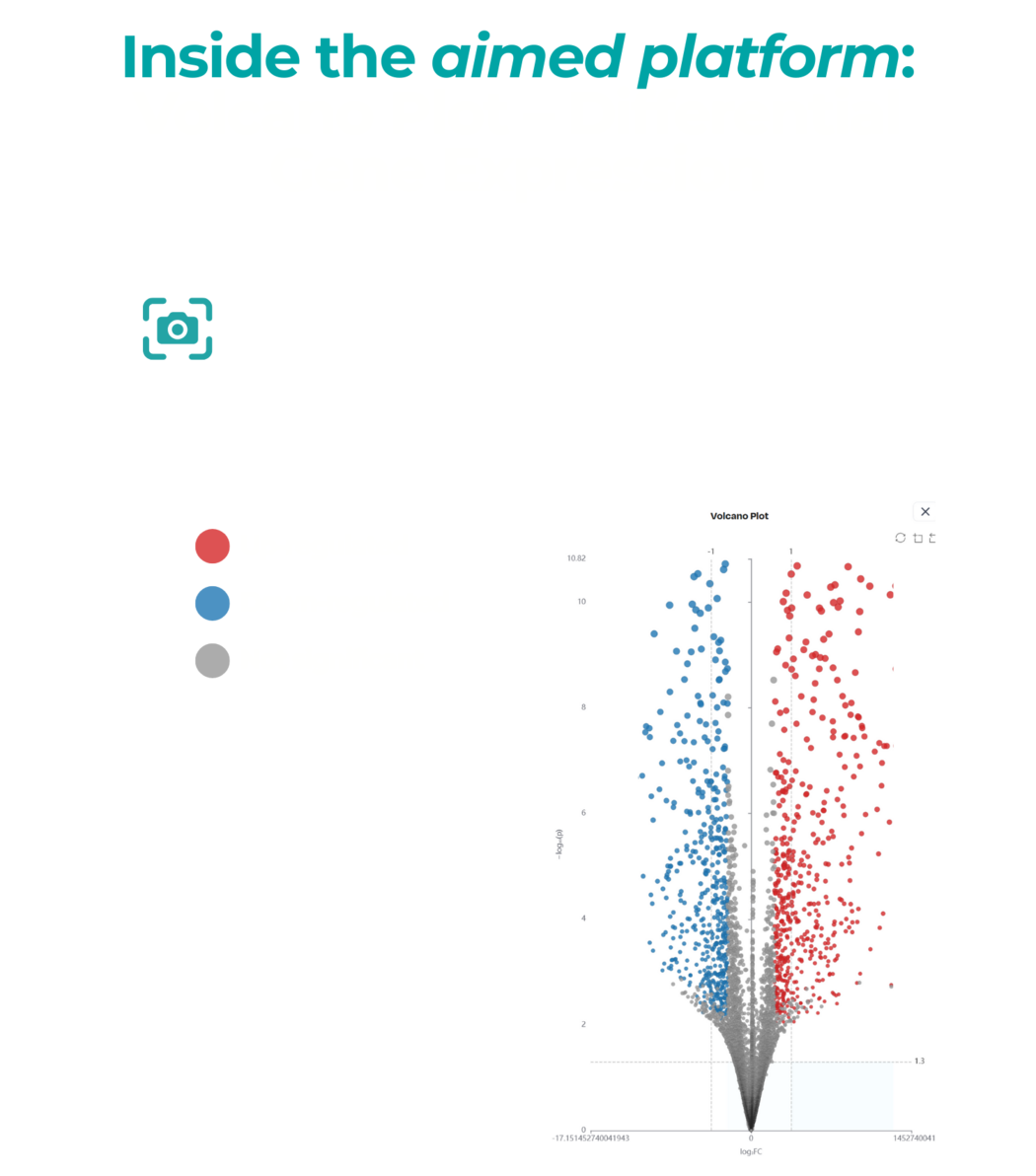
The system automatically creates model designs, runs DESeq2 analysis, and visualizes the top differentially expressed genes — all in a reproducible workflow.
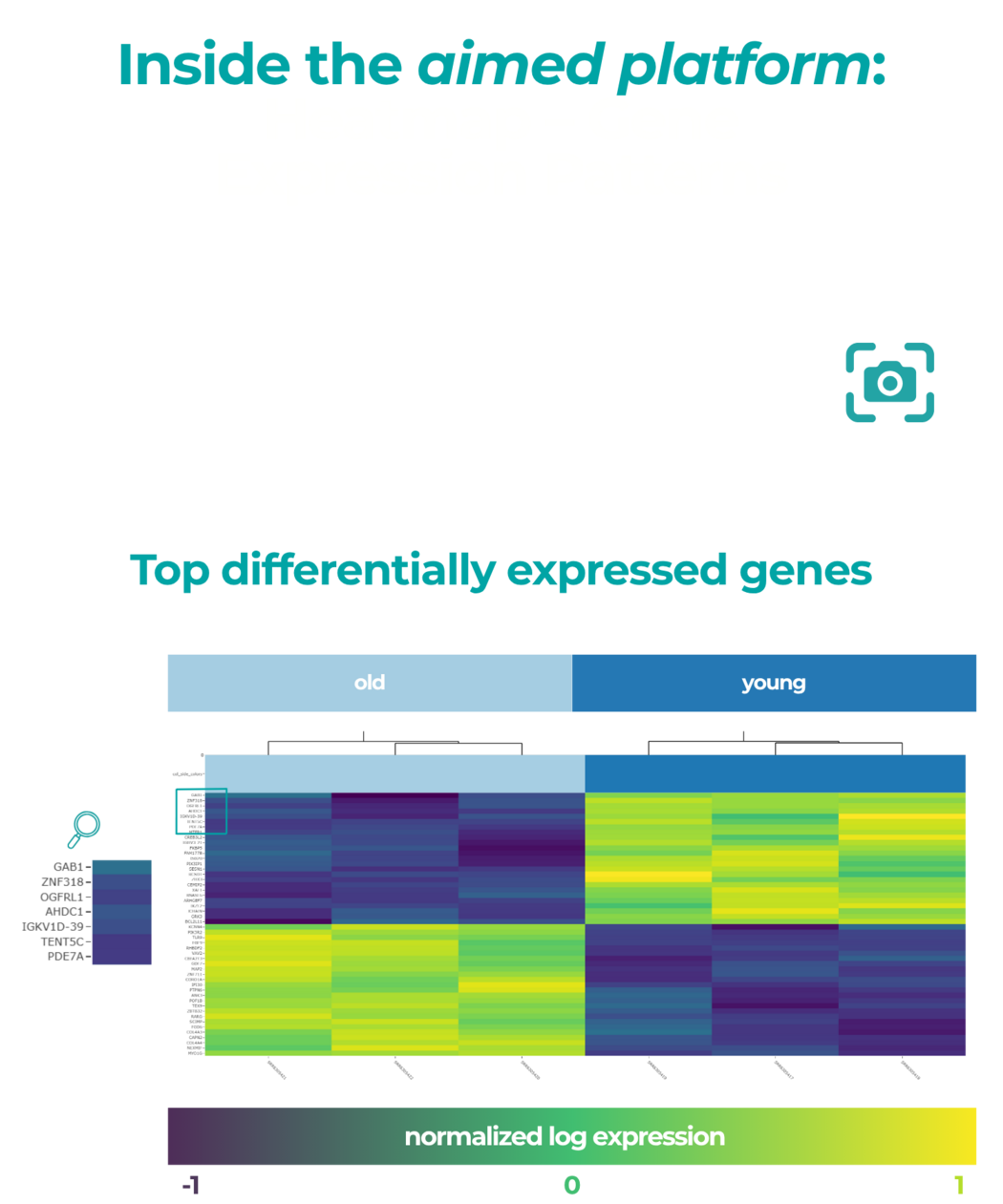
With agentic AI these results are not just fast. They are consistent, transparent, and ready for collaboration — and they automatically place findings within the broader context of scientific knowledge and literature, helping researchers interpret results faster.
Resetting Biomedical Analytics
The biomedical field doesn’t lack data. It lacks time and cost-effective insights. By resetting how analysis is done, we empower researchers and companies to move faster, more affordably, and with greater confidence.
This isn’t just about efficiency. It’s about enabling breakthroughs that matter: faster drug discovery, more targeted therapies, and research that translates into real-world impact.
The reset in biomedical data analysis has already begun — and it’s changing how biotech teams work.
👉 Ready to join? Request a demo.